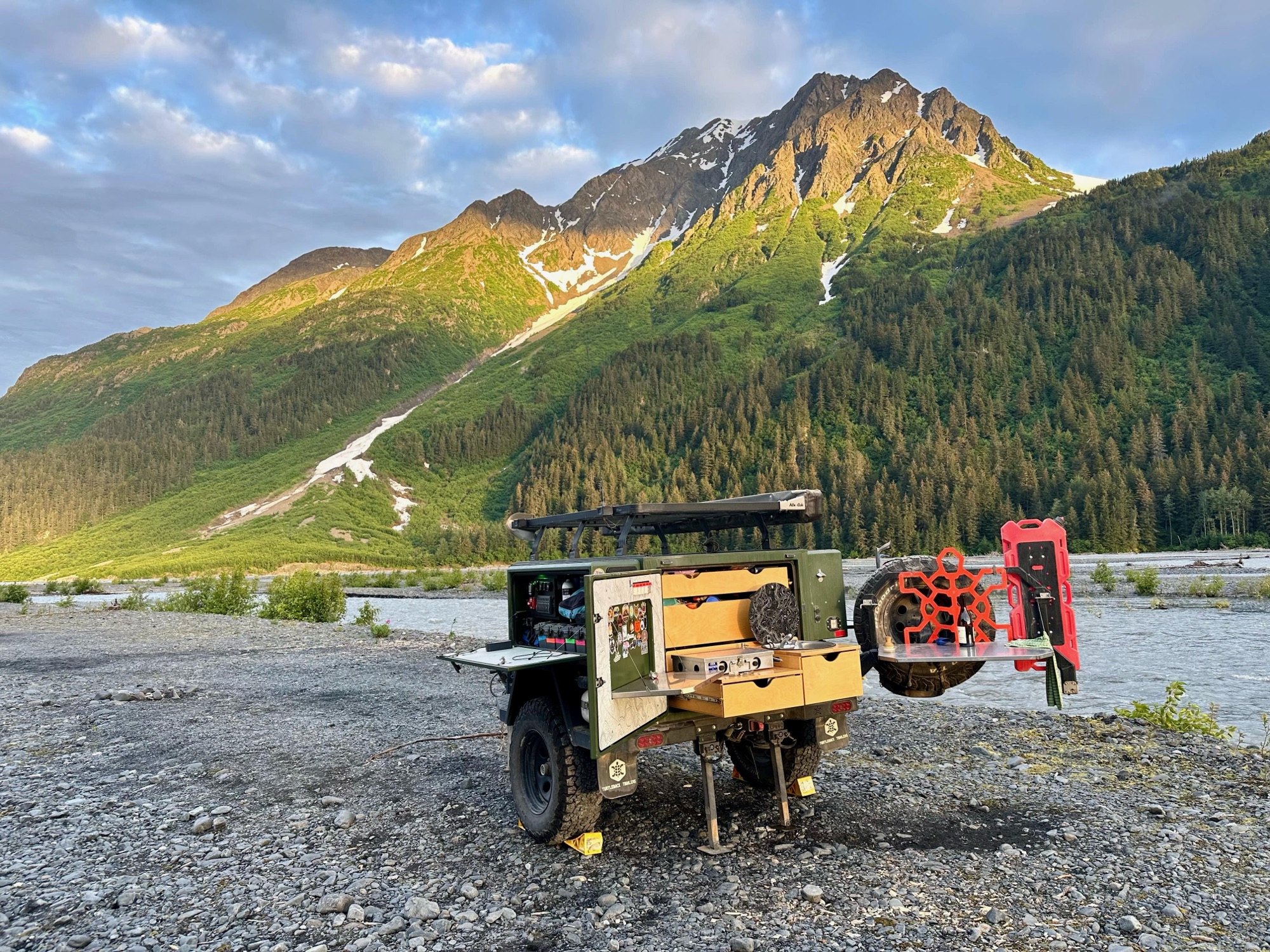
2021 Turtleback Expedition at a backcountry camp beneath snow-streaked mountains

Turtleback's Field Tester · Owners-Group Lead

I Find What Breaks.
This One Doesn't.

I'm Keith. From 2018 to 2023 I was Turtleback's product tester — the person who found the weak points and helped engineer the fixes — and I still run the owners community today. This 2021 Expedition is mine: every known failure point solved, all wear parts refreshed, and a complete backup set of running gear so you can get far and still get home.

  • 3500 HD bolt-on spindles — field-replaceable
  • Cruisemaster DO35 coupler — zero slop
  • Includes a complete spare rolling assembly
Asking $22,000
Tempe, Arizona

The Story

I didn't just own this trailer — I helped engineer it.

I saw my first Turtleback at Overland Expo in 2015 and got hooked — on the build quality, and just as much on the community that formed around these trailers. People from every walk of life, brought together by the outdoors. I bought my first one in 2017 and ran it hard all over the western U.S. By 2018 I was hosting Turtleback's community "herd of turtles" events, and I kept running them until 2023, when the company was sold and relocated to Tennessee. A lot of my closest friends today are people I met through these trailers.

In 2019 I started consulting on the product and doing field testing for Turtleback. My job, basically, was to find what breaks — and I was good at it. The upgrades that came out of that testing are a big part of why a modern Turtleback is as reliable as it is. This trailer has all of them, because it's the one I kept for myself — and the one I've put about 40,000 miles on, across eleven western states, three Canadian provinces/territories, and Alaska.

The biggest one was the suspension. The original design welded undersized 3,000-lb spindles into the trailing arms, and off pavement they broke — sometimes a ruined trip, sometimes a rolled, totaled trailer. The feedback I gave led to the Timbren 3500 HD spindle: a 7,200-lb unit derated to 3,500, on a redesigned arm that bolts on and is field-replaceable. They're symmetric, so one spare covers both sides and you can swap a corner on the trail. To my knowledge nobody has broken one of the new spindles.

The same thinking runs through the whole trailer. I relocated the Guzzle water-purification system off the vibrating rear panel into the protected internal cage and added a service hatch. I designed a proper mount for the water heater after watching several of the factory setups crack and leak on Death Valley washboard. I pulled the heavy steel roof rack and rooftop tent for a lightweight Front Runner aluminum rack and a right-sized OVS 270° awning — lighter up high means a lower center of gravity and a trailer that's far harder to roll.

This trailer rides on brand-new ICON shocks with about 5,000 miles, and carries its own insurance: a full backup set of ICON shocks rebuilt by Podium Suspension, two spare spindles, spare hubs, and two sets of pre-greased, vacuum-sealed bearings. The whole point is confidence — that you can get deep into somewhere remote and know you'll get back. Honestly, I'm only selling because we bought a Tundra with an OVRLND camper, and as we built that out we used the trailer less and less. It's spent the past year sitting under cover in the backyard — and it deserves better than that. It needs to go to someone who'll actually use it the way it was built to be used.
When you buy this trailer, you're not on your own. I'll take you out on a trip, teach you the systems, show you what it can really do — and bring you into the Turtleback community.
KeithTurtleback Field & Durability Tester · Herd-Event Host 2018–2023 · Owners-Group Lead

For nearly a decade I've been the person Turtleback owners come to. I ran the brand's community events from 2018 to 2023, I did the field testing that shaped the trailers people tow today, and I still run the owners group (these days on Discord). Buying from me means the most informed walkthrough you'll find for a Turtleback — and a standing offer to keep helping: a shakedown trip together, hands-on time with every system, and an introduction to a community that genuinely looks out for each other.

Featured by Lifestyle Overland

The Full Walk-Around

This complete walk-around was filmed by Lifestyle Overland back in July 2022, so a few details have changed since. It's still the best moving tour of the trailer's systems and storage, and you'll spot this trailer in several other Lifestyle Overland videos too.

Signature Upgrades

First-in-class hardware, sorted by the person who helped engineer it.

Two of these were genuine production firsts. The rest are the deliberate upgrades and fixes that come from knowing exactly where a platform needs help.

First Production

Timbren HD 3500 Axle-Less Spindles

The fix for the Turtleback's old Achilles' heel — and I helped find it.

Timbren's Axle-Less system replaces a solid axle with independent spindle arms bolted to the frame, each on a self-contained rubber spring. The HD 3500 spindle is a 7,200-lb unit derated to 3,500 lb, and the trailing arm is redesigned so the spindle bolts on instead of being welded in — making it field-replaceable. This was the first production Turtleback to run it.

Why it mattersThe original design welded undersized 3,000-lb spindles into the trailing arms, and off pavement they broke — anywhere from a flat-bed-home inconvenience to a rollover that totaled the trailer. The field testing I did for Turtleback drove the move to this 7,200-lb bolt-on spindle. It's dramatically stronger — to my knowledge nobody has broken one — and because it bolts on and is symmetric side-to-side, you can carry a single spare and rebuild a corner on the trail. I wouldn't tow any Turtleback off pavement without it.

First Production

Cruisemaster DO35 Off-Road Coupler

360° articulation with zero slop — and none of the Max coupler's failure mode.

The DO35 is an off-road articulating coupler rated to 3,500 kg that replaces a fixed ball or lunette. Its poly-block pivot allows full 360° rotation between truck and trailer, absorbing twist, pitch, and roll independently of the tongue.

Why it mattersI've run the alternatives and watched how they age. The Max coupler develops slop — it has multiple points that fatigue as that play works into the system, and I've personally seen Max couplers catastrophically fail and break off-road. The DO35 is a far more substantial piece with no slop and a much more precise feel. It keeps the trailer tracking true on ledges and off-camber lines instead of fighting the truck, and it isn't pumping torsional stress into the frame the way a ball hitch does.

Front Runner Roof Rack

Heavy steel rack and tent gone — lighter up high, lower center of gravity.

A lightweight Front Runner aluminum rack replaces the heavy stock steel carrier. It's an industry-standard platform, so almost any accessory — lights, RotopaX, shovels, the awning — mounts with purpose-built hardware and no drilling or fabrication.

Why it mattersAs our setup evolved we stopped using a rooftop tent, and I wanted the weight off the top. Swapping the steel rack and tent for this aluminum rack — paired with a right-sized OVS 270° awning on the driver's side, where you actually spend your time — pulls a lot of mass down low. That lowers the center of gravity, which makes the trailer more stable and far less likely to roll. The Front Runner ecosystem also means you can reconfigure the roof trip to trip without drilling a thing.

Goal Zero Yeti 1500X Power System

1,500 Wh, 2,000 W pure sine — and three ways to recharge.

The electrical system is built around a Goal Zero Yeti 1500X (1,500 Wh) with a 2,000 W pure sine wave inverter and a live capacity display. It recharges three ways: a 10A DC-to-DC charger off the tow rig (via the 7-pin), a 100 W Renogy rigid solar panel on the roof rack, and 10A shore power. It's the trailer's entire power hub — removable, standalone, and independently serviceable.

Why it mattersFixed 12V wiring is notoriously hard to diagnose when it fails — and on a trailer that sees real off-road miles, it eventually does, usually 60 miles from pavement on a Friday night. Building around the Yeti sidesteps that fragility: it's self-contained, its charge is on the display at all times, and a clean 2,000 W pure sine output runs real appliances without the hum or harmonics of a cheap inverter. With DC-to-DC, solar, and shore charging all wired in, you top off however the trip allows — and if it ever needs service, you pull it out without touching the trailer's structure.

Guzzle H2O Filtration & Purification — Relocated

Backcountry water you can drink — relocated and made serviceable by me.

The Guzzle H2O system filters and purifies water from streams, lakes, or sketchy fill stations so it's safe to drink. On this trailer I relocated it from the factory rear-panel position into the protected internal cage and added a dedicated access hatch.

Why it mattersTurtleback's water-purification option actually traces back to my first trailer — the first to run a water-cleaning system, which is what led to the Guzzle. The factory mounted it on the rear panel, where it took heavy vibration and made the panel a pain to pull for service. I moved it into the internal cage and added a hatch, so it's better protected and genuinely easy to maintain — field filter swaps take minutes. Being able to safely drink from a backcountry source means less water weight and more range.

Reinforced Water Heater Mount

I watched these crack in Death Valley — so I engineered the fix.

The propane water heater sits on a support I designed, and the factory thermostatic mixing valve has been removed. Together that ends the cracking failure the stock setup was prone to.

Why it mattersFactory heaters were cracking at the stainless plumbing stubs for two reasons: a thermostatic mixing valve hung extra weight off that stub, and the heaters weren't properly secured. On long washboard — Death Valley is the classic — they'd crack and leak all over the trailer. I designed a mount that properly supports the heater inside the box and removed the mixing valve that was loading the stub. It's the version of this part that doesn't fail on you mid-trip.

New ICON Shocks (~5,000 mi)

Fresh damping up front — with a rebuilt spare set in the boxes.

The trailer rides on brand-new ICON shocks with roughly 5,000 miles on them, matched to the Timbren Axle-Less geometry.

Why it mattersShocks are the consumable every used-trailer buyer wonders about. Here they're simply new, with low miles and plenty of life left — no guessing about age or wear. And you're not left exposed when they eventually do need attention: a full backup set, professionally rebuilt by Podium Suspension, rides in the trailer (see the spares card).

Carries Its Own Spare Running Gear

A complete second set of running gear — rebuild a corner in the backcountry.

The trailer carries its own spare running gear: a complete second set of Timbren 3500 HD bolt-on spindles, a backup set of ICON shocks professionally rebuilt by Podium Suspension, two sets of wheel bearings (pre-greased and vacuum-sealed), and a spare wheel hub.

Why it mattersIndependent suspension is only as good as your ability to fix it far from a shop. Because the Timbren spindles bolt on and are symmetric side-to-side, a damaged corner becomes a trailside repair instead of a flatbed call — and this trailer hands you every part to make it: spindles, shocks, sealed bearings, and a hub. That's the whole idea — get deep into somewhere remote and know you can get back. It's the kind of redundancy you build only after you've been the one stranded.

BFGoodrich KO3 Tires — Load Range E

New 285/70R17 rubber on 17-inch steel — and it runs your truck's spare.

Two new BFGoodrich All-Terrain T/A KO3 tires in 285/70R17, mounted on 17-inch steel wheels in the Toyota 6-lug pattern — the current generation of BFG's benchmark all-terrain, with updated sidewall protection and compound.

Why it mattersRunning the Toyota 6-lug pattern is a quiet but real advantage: trailer and tow vehicle can share wheels and tires, so one spare covers both and you can rotate rubber across the whole rig. The KO3 is the proven overland all-terrain — tough sidewalls for shelf-road rocks, predictable manners on the highway. New tires are new tires: no guessing about age, UV, or prior damage. With the rebuilt suspension, the rolling gear here is genuinely fresh.

Bedlined Chassis & Olive Drab Build

A finish built to get hit — in a colorway that doesn't look like everything else.

The chassis is coated in a Line-X-style spray-on bedliner — the same material used in truck beds to resist abrasion, impact, and corrosion. The body is finished in olive drab, a matte military green, with a burnt-orange accent on the turtle emblem.

Why it mattersBare frames corrode; painted frames chip, and chips corrode. Bedliner is a different animal: it absorbs rock strikes that would chip paint, seals the substrate against moisture, and needs no touch-up because minor abrasion vanishes against the texture. On a trailer that drags through brush and bounces through creek crossings, it's the correct finish — and the matte olive hides trail dust and scuffs that would make a gloss build look thrashed after a weekend.

The Numbers

Specifications

Dimensions & Weights

Length (exterior)
154 in · 12 ft 10 in
Width (exterior)
75 in · 6 ft 3 in
Overall height (no tent)
66 in · 5 ft 6 in
Ground clearance
18+ in
Dry / base weight
≈ 1,850 lb
GVWR
3,250 lb
Tongue weight (static)
≈ 300 lb

Coupler & Towing

Coupler
Cruisemaster DO35 off-road coupler
Handbrake
Cruisemaster handbrake
Articulation
360° axial rotation; multi-axis pitch & roll
Coupler rating
3,500 kg (3.5 T)
Brakes
Electric drum + breakaway switch
Tow vehicle
Mid-size 4x4 and up recommended

Suspension & Chassis

Spindles
Timbren 3500 HD — field-replaceable bolt-on
Rating
7,200 lb spindle derated to 3,500 lb; axle-less independent
Shocks
ICON — new, ≈ 5,000 mi
Frame
Welded steel tube
Chassis finish
Line-X-style bedlined black
Body finish
Olive drab; burnt-orange turtle emblem

Tires & Wheels

Tires
BFGoodrich All-Terrain T/A KO3 (2 new)
Size
285/70R17
Load range
Load Range E
Wheels
17 in steel · Toyota 6-lug
Spare
Full-size spare on swing-away carrier

Electrical & Power

Power station
Goal Zero Yeti 1500X — 1,500 Wh
Inverter
2,000 W pure sine wave
Charging
10A DC-DC (7-pin) · 100W Renogy solar · 10A shore
Aux panel
8-circuit Blue Sea breaker panel
Architecture
Portable Yeti — removable, no hard-wired bank

Comms & Lighting

Ham radio
Yaesu FTM-300D — MARS-modified for GMRS
Signal booster
weBoost — antenna currently removed
Flood lights
Rigid D2 (rear)
Rock lights
KC RGB
Lighting
Interior & exterior LED

Water System

Capacity
48 gal total — 42 fresh + 6 heater
Water heater
Dometic 6-gal propane — mount reinforced
Purification
Guzzle H2O filtration & sanitization — relocated, with maintenance hatch
Drinking spout
Dedicated galley spout for filtered water
Pump
12V on-demand
Outdoor shower
Plumbed hot/cold

Galley & Kitchen

Galley
Slide-out rear galley
Stove
Cook Partner 2-burner steel stove
Sink
Stainless, hot & cold
Finish
Topo-vinyl wrap — door, drop tables & sink underside
Cutting board
Custom walnut
Utensils
Front Runner set + Turtle Claws
Refrigeration
Fridge slide (confirm inclusion)
Storage
Locking drawers & weather-sealed side doors

Propane & Fire

Bulk tank mount
Chassis-secured bulk propane mount
Propane tank
30 lb tank included
Fire pit
Square propane fire pit included

Storage & Protection

Door panels
MOLLE on storage doors
Nose box
Bed-coated impact pads
Paint protection
Clear PPF on large flat surfaces
Box tops
Diamond plate
Box floors
Rubberized raised floors — gear stays dry
Aux fuel
RotopaX 4-gal carrier (rear)
Stabilizers
ARK corner steadies

Roof, Rack & Camp

Roof rack
Front Runner Slimline aluminum
Awning
OVS 270° (driver-side mount)
Solar
100W Renogy rigid panel on rack
Rack mounts
Front Runner antenna + shovel mounts
Rooftop tent
Present — confirm inclusion
Prep table
Fold-down on spare-tire swing arm

Included Spares & Redundancy

Spindles
Complete 2nd set — Timbren 3500 HD bolt-on
Shocks
2nd set of ICON shocks — rebuilt by Podium Suspension
Bearings
Two sets — pre-greased & vacuum-sealed
Hub
Spare wheel hub

Figures compiled from Turtleback published specifications and owner records. Items marked with a dotted underline are confirmed in person at sale; exact weights, dimensions, and equipment inclusions verified before purchase.

Full Disclosure

Mechanically dialed. Cosmetically honest. Remarkably well-kept.

I'll be straight with you: this trailer has about 40,000 miles of real trails on it, and it's earned a few honest trail badges — rock chips and some light pinstriping from brush. But for the miles, it's in remarkably good shape, mechanically and cosmetically. The large flat surfaces are protected with clear paint protection film, the galley areas that take the most abuse have a vinyl topo wrap, and the nose box and panels have impact pads that have genuinely done their job — most of the patina you'll find is right at the edges those pads don't cover. It's been kept under cover in a dry Arizona climate, and I've thoroughly cleaned and polished every inch. It looks great. It isn't perfect, and I won't pretend it is — but it's about as well-preserved as a trailer this well-traveled gets.

  • Strength: Mechanical About as close to perfect as a used trailer gets — fully tested, trail-proven, and ready to go
  • Strength: Suspension Timbren 3500 HD bolt-on spindles and brand-new ICON shocks (≈ 5,000 mi); full spare set included
  • Strength: Paint protection Clear film on all large flat surfaces; vinyl topo wrap on the galley areas that see the most wear
  • Strength: Impact protection Impact pads on the nose box and panels, plus diamond plate over the side-box tops — they've done their job, so the patina is mostly just at the edges they don't cover
  • Strength: Storage Kept under cover in a dry Arizona climate; thoroughly cleaned and polished
  • Honest note: Travels ≈ 40,000 miles across 11 western states, three Canadian provinces/territories, and Alaska — the bugs are well shaken out
  • Honest note: Cosmetics Honest trail badges: rock chips and light pinstriping — remarkably clean for the mileage

Straight Answers

Frequently Asked Questions

Upgrades & Mods

Why is the roof rack different from stock — and is that a good thing?

I replaced the stock rack with a Front Runner Slimline-style aluminum rack, and it's one of the best upgrades I made. It's substantially lighter than the factory rack, which matters when you stack gear up high — lower weight up there means better articulation and handling on rough terrain. It's also far more modular, so you can mount Rotopax, lighting, or other accessories with purpose-built hardware instead of improvised clamps. Every owner I know who's made this swap has never looked back.

Why was the Guzzle H2O system relocated — does that change how it works?

It works identically; I relocated it purely for mounting security and serviceability. In the stock spot it was exposed to more vibration and harder to reach for filter changes on the trail. The new location is more protected, better braced, and far easier to service in the field. I've done this relocation on other Turtlebacks based on owner feedback, and the day-to-day improvement is immediately noticeable.

Maintenance & Condition

Why was the water heater mount reinforced — should that concern me?

The opposite — it should reassure you. The water-heater mount was a known vulnerability on early builds; I identified it in my role as Turtleback's field tester before it became widespread. The stock mount wasn't robust enough for sustained off-road vibration, and owners who didn't address it eventually dealt with loosening or damage. I reinforced it properly. You're buying the version of this trailer that's already had the problem solved — not the one where it's still waiting to happen.

What's the condition of the body and exterior?

Honest answer: it has about 40,000 miles on it and has earned a few trail badges — rock chips and some light pinstriping from brush. But it's held up remarkably well. The large flat surfaces are protected with clear paint protection film, the galley areas that get dirty wear a vinyl topo wrap, and the nose box and panels have impact pads that did their job — the patina is mostly right at the edges those pads don't cover. It's been kept under cover in a dry Arizona climate, and I've cleaned and polished every inch. It's not factory-fresh, and I won't pretend it is — but for a trailer that's actually been used this much, it looks great.

Specs & Capability

Why do the Timbren HD 3500 axle-less spindles matter so much?

Because they fix what used to be the Turtleback's Achilles' heel. The original design welded undersized 3,000-lb spindles into the trailing arms, and off pavement they broke — outcomes ran from a flat-bed-home headache to a broken spindle that rolled and totaled a trailer. The field testing I did for Turtleback drove the move to the 3500 HD: a 7,200-lb spindle derated to 3,500, on a redesigned arm that bolts on instead of being welded. It's far stronger (to my knowledge nobody has broken one), it's field-replaceable, and it's symmetric, so a single spare covers both sides and you can rebuild a corner on the trail. Honestly, I wouldn't tow any Turtleback off pavement without these.

What is the Cruisemaster DO35 coupler, and why not a Max coupler?

The DO35 is an off-road coupler that articulates 360° through a poly-block design. I've run the alternatives, and the difference matters: the Max coupler develops slop, with multiple points that fatigue as that play works into the system, and I've personally seen Max couplers catastrophically fail and break off-road. The DO35 is a far more substantial piece with no slop and a much more precise feel — it keeps the trailer tracking correctly on ledges, V-ditches, and off-camber lines instead of fighting the truck. It's considered best practice in the overland space, and this trailer has it.

What tow vehicle do I need?

It depends on your loaded weight, but the practical pairing is a mid-size 4x4 and up — think Tacoma, 4Runner, Land Cruiser, Tundra, Wrangler, or equivalent body-on-frame trucks and SUVs. Four-wheel drive is strongly recommended if you plan to take this trailer where it was designed to go. Tell me what you're towing with and I'll give you a direct answer on compatibility.

Buying

Why buy a heavily-used trailer instead of something newer with fewer miles?

Because on an overland trailer, maintenance history and who kept it matter far more than miles. I did the field testing that shaped these trailers, I ran the community events for years, and I'm who owners across the country still contact when something goes wrong. This one has been kept by the person who knows the platform best: the suspension runs the 3500 HD bolt-on spindles and new ICON shocks (with a rebuilt spare set aboard), new KO3 Load Range E tires are mounted, and every known vulnerability has been engineered out. You're not buying a tired trailer — you're buying the most sorted Turtleback you're likely to find, from the person who made it that way.

What comes with it — and will you help me learn to use and maintain it?

It comes loaded: the Goal Zero Yeti 1500X power system, Front Runner roof rack, Guzzle H2O purification, OVS 270° awning, propane fire pit, RotopaX fuel carrier, and all the modifications described here. It also carries its own spare running gear — a complete second set of Timbren 3500 HD bolt-on spindles, a backup set of ICON shocks rebuilt by Podium Suspension, two sets of pre-greased, vacuum-sealed bearings, and a spare hub — so a damaged corner is a trailside fix, not a flatbed call. And yes, absolutely: I ran the herd events and still run the owners group, and I'd genuinely enjoy taking the new owner out on a shakedown trip, teaching the systems hands-on, and introducing you to the Turtleback community. That kind of support doesn't come with a trailer off a lot.

Where is it located, and is it titled and registered?

It's located in Tempe, Arizona. Reach out and I'll share complete title and registration details — I'll have full documentation ready for the buyer and will make the transfer process as clean and simple as possible.

What's the asking price?

The asking price is $22,000. This is a piece of Turtleback history with a very specific set of first-production distinctions, expert-level maintenance, and fully refreshed wear components — priced fairly for what it actually is. Reach out and let's talk; I'm happy to walk you through every detail behind that number.

Let's Talk

You're not just buying a trailer.

Serious inquiries welcome. I want this Expedition to go to someone who'll actually use it — and I'll help you do that: a shakedown trip together, hands-on time with every system, and an introduction to the Turtleback community. Reach out and let's talk. I can answer anything about this rig, because I lived every mile of it.

Tempe, Arizona  ·  $22,000